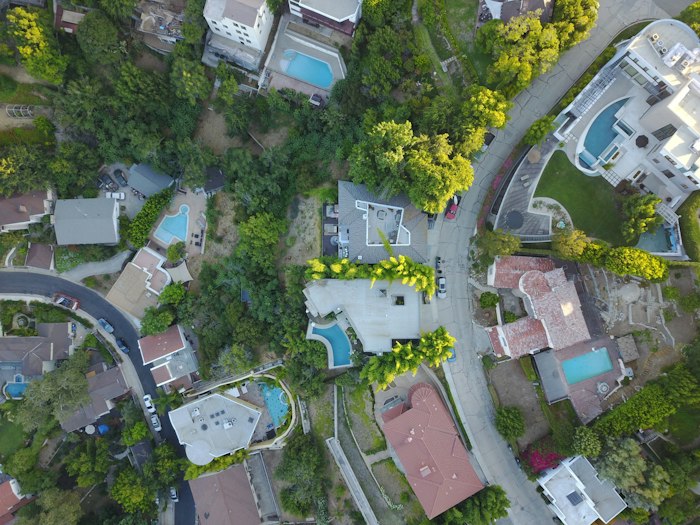
Westwood
Median $2,300,000
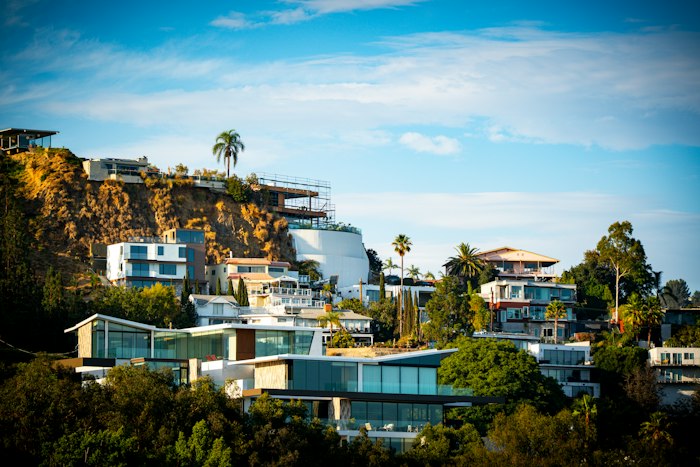
Playa Vista
Median $1,900,000
Two walkable, professional neighborhoods at very different price points.
Westwood and Playa Vista are both walkable, professional, mixed-use West LA neighborhoods — but they were built in different decades, for different buyers, with different relationships to their surroundings. Westwood is the older sibling: anchored by UCLA, defined by the village shopping district along Westwood Boulevard, with housing stock that ranges from the postwar Holmby Hills estates down to mid-century condos on Wilshire and tree-lined single-family on the South Westwood streets. Playa Vista is the planned new urbanist counterpart: built largely in the last 20 years on the Hughes Aircraft site, designed from scratch around walkability and Silicon Beach proximity, with newer condos, townhomes, and the Runway shopping district as a daily anchor. Both neighborhoods are popular with professionals who want to walk to dining, transit, and offices — but the buyer profiles are different, the housing stock is different, and the price points are noticeably different. This comparison breaks down the strategic case for each.
Westwood covers a remarkably wide range of housing types and price points for a single neighborhood designation. The South Westwood single-family streets between Wilshire and Pico have classic mid-century homes in the $2M to $4M range. The Wilshire corridor condos (the high-rises along the so-called Wilshire Corridor between Westwood Boulevard and the 405) trade at varying price points based on building, view, and updates — some are exceptional buys, others trade above $3M. Westwood Village remains the dining and entertainment heart, even after years of evolution. UCLA is the structural anchor: the university generates permanent demand from faculty, students, medical center staff, and parents of out-of-state students buying condos for their UCLA-attending kids. Median is $2.3M, days on market average 20, YoY appreciation is 7.2%. The case for Westwood is institutional stability — UCLA is not going anywhere, and demand from the university's ecosystem creates a permanent demand floor.
Playa Vista is the most successful new urbanist project in greater LA — a fully master-planned community built from scratch on the former Hughes Aircraft site, with a tight street grid, mixed residential and retail, parks, and direct walkability to the Runway shopping center. Median sits at $1.9M, days on market average 19, and YoY appreciation is 8.4% — faster than Westwood. The housing stock is overwhelmingly post-2010: newer condos, townhomes, and a smaller number of detached single-family. The buyer profile is heavily tech and creative-class — Google, YouTube, Riot Games, and several other major employers maintain Silicon Beach offices within walking distance. The strategic case is twofold: newer construction means lower deferred maintenance and higher rentability, and Silicon Beach employer demand maintains a strong renter pool for owners who eventually convert to investment use. The risk is that Playa Vista is a single architectural era; resale buyers want what is here, but the neighborhood lacks the architectural diversity of older Westside areas.
LAUSD with several strong magnet options. Warner Elementary, Emerson Middle School, University High School. Strong private alternatives including Harvard-Westlake (middle), Marlborough, and Brentwood School within a 10-minute drive.
LAUSD with Playa Vista Elementary serving the neighborhood directly. Strong private alternatives including Westside Neighborhood School and Wildwood. Schools are less a primary driver here than the tech employer concentration.
Westwood Village dining and theaters, Hammer Museum, UCLA athletic and cultural events, Geffen Playhouse. Strong walkability to UCLA. Quick freeway access to the 405. Dense, urban, university-town energy.
Runway Playa Vista shopping center anchors daily life with Whole Foods, restaurants, gyms, and a movie theater. The Bluff Creek Trail and Ballona Wetlands provide unusually strong outdoor access for an urban LA neighborhood. Tech-campus walkability.
Westwood has the widest architectural range of any West LA neighborhood at its price point. The South Westwood single-family streets between Wilshire and Pico have classic mid-century homes from the 1940s and 1950s on 5,500 to 7,500 square foot lots. The Wilshire Corridor has a remarkable collection of mid-century and contemporary high-rise condos — buildings like the Sierra Towers, the Westwood Comstock, and the Westford have architectural significance and varying buyer profiles. North of Wilshire approaches Holmby Hills and Bel Air estates at much higher price points. Westwood Village itself has historic 1920s and 1930s commercial architecture preserved alongside modern student-oriented retail. The range means buyers can enter at $700K (older condos) to $20M+ (Holmby-adjacent estates).
Playa Vista's housing stock is the most architecturally uniform in West LA — by design. The master-planned community was built almost entirely between 2003 and 2020, with a coordinated palette of contemporary multi-family condos, modern townhomes, and a smaller number of detached single-family homes. Buildings cluster around shared courtyards and parks, with consistent setbacks, height limits, and material selections. Notable parcels include the Crescent Park townhomes, the Concerto condos, and the single-family inventory in the Promenade neighborhood. The uniformity is appealing to buyers who value coordinated community design; buyers who want architectural variety should look elsewhere. The post-2010 build dates mean lower deferred maintenance and modern energy efficiency throughout.
Westwood's 20-day average days-on-market masks substantial variation by sub-market. Wilshire Corridor condo activity depends heavily on building reputation and HOA health — some buildings move in days, others take months. South Westwood single-family stock moves fast (under 15 days for well-priced homes) because of UCLA-adjacent family demand. Inventory is most varied in summer, partially driven by faculty relocations and out-of-state student parents purchasing condos. The strongest buyer leverage comes in late fall, before the spring family-move season begins. Off-market activity is meaningful in the Wilshire Corridor tier.
Playa Vista's 19-day average reflects concentrated demand from Silicon Beach employers within walking distance. The market is unusually transparent because uniform housing stock makes comparable analysis straightforward — buyers can underwrite a Playa Vista condo or townhome with more precision than equivalent Westwood inventory. Inventory is most plentiful in spring; tech-employee buyer demand peaks late summer and early fall after annual stock vesting cycles. The 8.4% YoY appreciation has been steady, not volatile. HOA fees are a significant ongoing cost component and should be modeled carefully in any underwriting.
Best fit: UCLA-adjacent buyers (faculty, medical center, parents of UCLA students). Long-term holders. Buyers seeking institutional demand stability. Often older first-time buyers or downsizers.
Best fit: Tech and creative professionals in their 30s and 40s. First and second-time buyers. Buyers prioritizing newer construction and walkable amenities over architectural character.
Investment thesis: Westwood is the institutional stability play with permanent UCLA-driven demand creating a structural floor — appreciation is moderate (6 to 8% historical) but resilience through cycles is exceptional. Playa Vista is the tech-employer concentration play with 7 to 10% appreciation and newer construction reducing maintenance reserves. For long-term holders and investors prioritizing demand stability that cannot be displaced by any one industry, Westwood is the institutional choice. For 5 to 10 year holders aligned with tech employment cycles and willing to accept HOA fee structures, Playa Vista offers stronger near-term total return potential and significantly easier rental conversion at exit. The strategic fit depends heavily on which buyer profile aligns with your own employment and family situation.
Westwood if you want established prestige, UCLA proximity, and broad housing diversity from single-family to high-rise condos. Playa Vista if you want newer stock, Silicon Beach employer proximity, and a fully walkable master-planned community at a slightly lower entry point. Westwood offers more architectural variety and longer-term institutional demand stability. Playa Vista offers newer construction, lower maintenance, and a more uniform community design. The $400K price gap reflects Playa Vista's newer-build value and Westwood's institutional premium.
"Playa Vista's newer housing stock and tech employer proximity make it a compelling buy for the 30 to 45 demographic — buyers who care more about energy efficiency, smart-home wiring, and a 10-minute walk to a Google office than they do about original 1940s details. Westwood holds its value incredibly well because of UCLA, which is structurally permanent demand. A condo or single-family in Westwood is buying into a demand pool that includes every parent of every out-of-state UCLA student for the next 50 years. If you want yield and lifestyle, Playa Vista. If you want institutional stability and a hedge against any one industry, Westwood. I have closed in both and the buyer profiles are completely different — be honest about which one you are."
Talk to Anthony — Free →Playa Vista is more affordable, with a median of $1.9M compared to Westwood at $2.3M. The $400K gap reflects newer construction in Playa Vista versus Westwood's more diverse and often older housing stock.
Playa Vista is appreciating slightly faster at 8.4% YoY versus Westwood at 7.2%. Playa Vista benefits from concentrated tech employer demand; Westwood benefits from more stable but slower-growing institutional demand from UCLA.
Both are walkable, but in different ways. Playa Vista was designed from scratch for walkability — every home is within a 10-minute walk of the Runway commercial district. Westwood is walkable in pockets (Westwood Village, condos near the Wilshire corridor), but the neighborhood is larger and less uniformly walkable.
Yes. Silicon Beach employer concentration (Google, YouTube, Riot Games) maintains strong renter demand. Newer construction means lower maintenance and higher tenant appeal. Cap rates are competitive within the West LA market for buyers willing to convert to long-term rental.
Both are LAUSD, with comparable public school quality. Westwood has more nearby private school options. Schools are not a primary driver in either neighborhood — buyer decisions are more often based on employer proximity (UCLA vs. Silicon Beach) than school district.
Playa Vista is generally easier for first-time buyers — lower entry point, newer construction, smaller maintenance reserves needed, and a uniform condo and townhome market that simplifies comparables. Westwood offers more variety but requires more careful selection.
Westwood and Playa Vista are both excellent walkable, professional neighborhoods, but they sit at opposite ends of the West LA architectural and community-design spectrum. Westwood offers institutional stability, architectural variety, and UCLA-driven permanent demand at a higher entry point. Playa Vista offers newer construction, uniform planned-community design, and Silicon Beach employer proximity at a lower entry point. The right answer depends on whether you value architectural character or modern energy efficiency, whether you want a 50-year urban neighborhood or a 20-year master-planned community, and which employer base your career is anchored to. Reach out for a free CMA and strategy conversation tailored to your specific buyer profile.